
Perioral Dermatitis and Digestion: An Ayurvedic Perspective
By Nina Fine
Perioral Dermatitis and Digestion: An Ayurvedic Perspective
By Nina Fine, Ayurvedic Doctor (AyD) and licensed esthetician
If you've dealt with perioral dermatitis, you know the pattern: small red bumps clustered around the mouth, sometimes creeping toward the nose or eyes. If you think that's what you're seeing, start with a dermatologist, who can diagnose it and talk with you about treatment. As an Ayurvedic Doctor (AyD), licensed esthetician, and Ayurvedic practitioner at MySelf Ayurvedic Spa in Natick, MA, I offer something alongside that care: a look at your skin together with your digestion and daily habits.
What This Pattern Looks Like on the Skin
The pattern usually shows up as small, red, sometimes scaly bumps close to the mouth, often with a thin ring of clear skin right at the lip line. Many people notice it flares with certain lip products, toothpastes, or heavy creams, and that it comes and goes. From an esthetic standpoint, skin like this is sensitive and easily irritated. It calls for gentle care, not more actives. As a licensed esthetician, I start by stripping a client's routine back to the basics before adding anything new. Harsh scrubs, strong acids, and layering several new products at once can make sensitive skin feel worse, so with skin like this, less is usually more.
The Ayurvedic View: Digestion Comes Into the Conversation
In Ayurveda, skin is never read on its own. The tradition sees the face as one of the places where the body's overall balance shows. So as an Ayurvedic practitioner, I ask about meals, appetite, and how food sits with you, not just what's on your bathroom shelf. It doesn't replace your dermatologist. It's a second lens.
Ama, a Traditional Concept
Ama is a traditional Ayurvedic concept. It describes residue left behind when digestion doesn't fully complete, perhaps from rushed meals, unusual food combinations, or eating while stressed. In Ayurveda, steady digestion is valued for the whole body, skin included. Ama isn't tied to one dosha: the tradition describes it in Vata (air and space), Pitta (fire and water), and Kapha (earth and water) alike.
The Skin Dosha Method™: Reading Your Own Pattern
This is where The Skin Dosha Method™ comes in. It's the framework I created to look at skin alongside dosha, digestion, and daily habits, instead of using one generic approach for every face. Four common skin types describe what your skin is doing on the surface. The ten skin types of The Skin Dosha Method™ describe what is driving it. None of them is good or bad. Each is simply a starting point for understanding your own skin.
Curious which type you are? Take the free 2-minute quiz, or read more about The Skin Dosha Method™.
Kitchari and Ghee in Ayurvedic Cooking
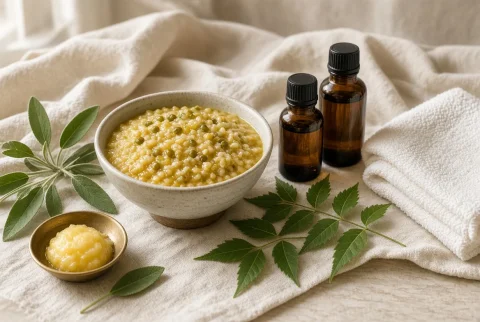
One of the simplest practices in Ayurveda is Kitchari, a nourishing meal of mung beans, rice, and mild spices. It's traditionally used as a short, gentle reset: easy to digest, so the system can rest rather than work harder. It's a food tradition, not a skin remedy.
Ghee shows up often in Ayurvedic cooking, too. Traditionally it's considered easy to digest and is used to support steady digestion, not as a fix for any skin condition. If you're thinking about adding ghee or any herbal formulation to your meals, check with your provider first if you take medication, are pregnant or nursing, or have a health condition.
At MySelf Ayurvedic Spa in Natick: Gentle Care for Sensitive Skin
At our Natick studio, I pair that conversation about digestion with hands-on esthetic care. A facial for redness-prone or sensitive skin is designed to feel calming, with gentle cleansing and soothing herbal formulations rather than anything that could aggravate an already sensitive area. If a product you're using starts to burn, itch, flake, swell, or cause bumps in new places, stop using it, and see a dermatologist if the reaction spreads or becomes painful.
Some clients also ask about Panchakarma, the supervised Ayurvedic cleanse practice. It's a traditional cleanse, not a skin service, and it isn't the right fit for everyone. I discuss it case by case, separately from any facial, and only with proper supervision.
Start With a Conversation, Not a Cabinet of Products
If your skin is confusing you, you don't need another shelf of products promising results. Keep working with your dermatologist, and if you'd like an Ayurvedic lens alongside that care, I'd be glad to help. We'll look at your skin, your digestion, and your daily habits together. Book a consultation at MySelf Ayurvedic Spa in Natick, MA, or start with the free skin type quiz.
For educational purposes only. Not medical advice. This article reflects Ayurvedic practice at MySelf Ayurvedic Spa. It is not a substitute for care from a physician or dermatologist. Ayurvedic care is complementary. Stop any product that burns, itches, swells, or breaks you out in new places, and see a dermatologist if a reaction spreads or is painful. If you are pregnant, nursing, managing a condition, or taking medication, talk with your provider before changing food, herbs, or cleanses.
© 2026 Nina Fine. The Skin Dosha Method™ is a trademark of Nina Fine.
Ready for the next step? Book your Skin Dosha Method™ consultation — call (339) 208-1788 or book online.
Tags
Ready to Experience Ayurvedic Care?
Start with a short skin quiz from Nina Fine, or book a personalized consultation.